Tuesday, November 30, 2010

Dependent Spirituality

“I’m just not able to do anything anymore. I feel like a burden to my congregation because I can’t help out the way I could before.”

Such was the lament of an aging member of a sister parish. The older she got, the less she could contribute. Most of the time we look forward to old age and the frailties it brings with anxiety. “I don’t ever want to be a burden on my family,” people wish. “I don’t ever want to be that dependent on others.”

More often than not, God leads us out of this life the same way he brought us into it: completely dependent on others. As infants, we relied on others to give us food, change our messy diapers, bathe us, clothe us, keep us safe from harm every minute of the day. We were completely dependent.

Then, as we grow into adults, we treasure our burgeoning independence. We can dress ourselves, bathe ourselves, feed ourselves. The more independent we get, we can cook for ourselves or even grow and gather our own food. We can transport ourselves wherever we need to go. A significant part of the American Dream is independence. So, naturally, growing older and more dependent upon others is looked on with shame by the world.

But not the church.

In fact, that God brings us down from our illusions of independence to reveal how truly dependent on others we are is a healthy lesson in humility. To learn to be dependent it to learn to be a Christian. When people were bringing infants to Jesus—yes, infants, the helpless, completely dependent, constantly-needing-to-be-fed-and-changed kind of people—He extolled them as model Christians: “To such belongs the kingdom of God. Truly, I say to you, whoever does not receive the kingdom of God like a child shall not enter it.” (Luke 18:15-17)

So whether at the beginning of your life, at the end, or numerous times in the middle, God is teaching you through dependence on others to be a Christian, a child of God, to inherit the kingdom of God. You did not make yourself a Christian; God made you one. You did not produce faith; God gave it to you. You do nothing to earn God’s favor; He gives it to you completely as gift. You are completely dependent on Him for every spiritual need.

So as your faculties decrease, as your strength wanes, as your ability to contribute to your congregation diminishes, rejoice. God is teaching you away from independence to complete dependence on Him.

When speaking of God, the old adage is false: it is not better to give than to receive. Faith receives what God gives. It is always better to be receiving from God than to be giving to Him. That’s what happens in the Divine Service: God comes to lavish His gifts of forgiveness, life, and salvation on us. We respond, giving Him our thanks and praise, of course. But the most important thing is that we receive what God gives.

In this season where giving is so highly exalted, don’t neglect the most important things: to be receiving from God. It’s a season chocked full of services, times when God and His Church interrupt your regular routine to bless you with more of His gifts. Don’t get so caught up in all the giving that you neglect the receiving.

Monday, November 1, 2010

All Saints' Day Reflection

To the cemetery or to the Altar? I found this from Lutheran pastor Berthold von Schenk while preparing for tonight's service. I'm reposting it from Pr. Petersen's and Pr. Cwirla's blogs.

It's from The Presence: An Approach to the Holy Communion, 1945, p. 130-132, reprinted in For All The Saints, v. 4, 1996.

When we are bereft of dear ones, it is a tremendous shock. For a time we are stunned. Not everyone, can feel at once their continuing companionship. We should not for that reason despair. An adjustment must take place in our lives, reaching deep into our habits, emotions and thoughts. Some souls may make this adjustment quickly. For most of us it comes slowly and hard; many an hour is filled with loneliness and agonizing doubt.

By ourselves we can never make this adjustment. We must come to a sense of the continuing presence of our loved ones, and we can do this if we realize the presence of our living Lord. As we seek and find our Risen Lord, we shall find our dear departed. They are with Him, and we find the reality of their continued life through Him. The saints are a part of the Church. We worship with them. They worship the Risen Christ face to face, while we worship the same Risen Christ under the veil of bread and wine at the Altar. At the Communion we are linked with heaven, with the Communion of Saints, with our loved ones. Here at the Altar, focused to a point, we find our communion with the dead; for the Altar is the closest meeting place between us and our Lord. That place must be the place of closest meeting with our dead who are in His keeping; The Altar is the trysting place where we meet our beloved Lord. It must, therefore, also be the trysting place where we meet our loved ones, for they are with the Lord.

How pathetic it is to see men and women going out to the cemetery, kneeling at the mound, placing little sprays' of flowers and wiping their tears from their eyes, and knowing nothing else. How hopeless they look! Oh, that we could take them by the hand, away from the grave, out through the cemetery gate, in through the door of the church, and up the nave to the very Altar itself; and there put them in touch, not with the dead body of their loved one, but with the living soul who is with Christ at the Altar!

Our human nature needs more than the assurance that some day and in some way we shall again meet our loved ones "in heaven." That is all gloriously true. But how does that help, us now? When we, then, view death in the light of the Communion of Saints and Holy Communion, there is no helpless bereavement. My loved one has just left me and has gone on a long journey. But I am in touch with her. I know that there is a place where we can meet. It is at the Altar. How it thrills me when I hear the words of the liturgy, "Therefore with angels and archangels and all the company of Heaven," for I know that she is there with that company of heaven, the Communion of Saints, with the Lord. The nearer I come to my Lord in Holy Communion, the nearer I come to the saints. to my own loved ones. I am a member of the Body of Christ, I am a living cell in that spiritual organism, partaking of the life of the other cells, and sharing in the Body of Christ Himself.

There is nothing fanciful or unreal about this: Indeed, it is the most real thing in my life. Of course, I miss my loved one. I should miss her if she took a long holiday trip. But now. since she-is what some people call “dead,” she is closer to me than ever. Of course, I miss her physical presence bitterly. I miss her voice and the sound of approaching footsteps. But I have not lost her. And when my sense of loss becomes too great, I can always go to our meeting place at the Altar where I receive the Body and Blood of my Lord that preserves my body and soul just as it has preserved her unto everlasting life.

Do learn to love the Altar as the meeting place with your beloved who have passed within the veil. Here again the Sacrament is the heart of our religion. The Blessed Sacrament links us not merely to Bethlehem and Calvary, but to the whole world beyond the grave as well. For at the Altar the infinite is enshrined in the finite, heaven stoops down to earth, and the seen and the unseen meet.

Oh, God the King of Saints, we praise and magnify Thy holy Name for all Thy servants, who have finished their course in Thy faith and fear, for the Blessed Virgin Mary, for the Holy Patriarchs, Prophets, Apostles, and Martyrs, for all Thy other righteous servants; and we beseech Thee that, encouraged by their example and strengthened by their fellowship, we may attain to everlasting life, through the merits of Thy Son Jesus Christ our Lord. Amen.

The Rev. Berthold Von Schenk (1895 - 1974)

Monday, September 27, 2010

Thinking about Opposites

Reflecting on the Gospel for Trinity 15 (Matthew 6:24-34), where Jesus says it’s impossible to worship both God and Mammon, has gotten me thinking about opposites.

Trust & Worry

Trust and worry, or trust and fear, are opposites. Worry and anxiety are evidence of a lack of faith, a lack of trust in God’s gracious provision, in His day-to-day protection. Thus the Creed teaches us that our Heavenly Father “defends us against all danger, guards and protects us from all evil.” He does, He really does. Childlike faith knows this and expects it at all times, just as a child expects complete and perfect protection from her father. To worry is to believe that God either is unable to take care of you or is unwilling to do so. Faith, rather, knows that God disciplines those whom He loves, giving them crosses to bear from time to time to conform them to His Son, that their lives might likewise be cruciform, that they might likewise love others selflessly.

Thankfulness & Entitlement

“Get the car that you deserve,” says the commercial on the radio, which pretty much summarizes most marketing: you deserve better. That’s the mindset of entitlement. You deserve something nice and comfortable, some handsome reward for your hard work. That’s what you deserve, so it’s what God should give you.

Again, the First Article of the Creed teaches differently. “All this He does only out of fatherly, divine goodness and mercy, without any merit or worthiness in me.” Faith is not concerned with entitlement, with what you think you deserve. Rather, repentant faith knows you deserve nothing good. Everything good you receive, is because of God’s fatherly, divine goodness and mercy. So faith receives all the daily bread God provides with thankfulness, not entitlement.

Forgiveness & Tolerance

One of the culture’s highest virtues is tolerance. Despite how liberal Christians want to reinterpret God, though, He is anything but tolerant. If He were tolerant of sin, foibles, peccadilloes, or deviations from His law, He would not have sent His Son to die for sin. If tolerance were an option, forgiveness would not be necessary. Instead of “tolerant,” God describes Himself as “gracious and merciful, slow to anger, and abounding in steadfast love.”

Faith seeks not tolerance from God but forgiveness. In repentance, faith acknowledges that God is intolerant of our sin and even intolerant of sinners. The proof of God’s intolerance, of His hatred for sin, is on the cross. There, sin’s ugliness and God’s contempt for sin and sinners was displayed when God the Son cried out in dereliction—abandonment—to an unanswering God the Father. The Father had no ear for Jesus’ plea, having laid on Him the sin of all humanity, having made Him who knew no sin to be sin for us.

Unbelief seeks tolerance, acceptance of our sins. Faith looks to Jesus for forgiveness. Faith knows that Jesus answered for all sin, so that we might be the very righteousness of Jesus.

All of these pairs are essentially expressions of faith and unbelief, which are opposites in every way. I’m sure there are plenty more expressions of faith and unbelief that are opposites, but these are the ones I’ve been thinking about the most.

Faith is a gift; unbelief is a work. Faith clings to Jesus; unbelief trusts in our selves. Unbelief lives inside the self; faith lives externally, in receiving the gifts God delivers outside ourselves and in loving and serving those we encounter in our vocations.

Monday, September 20, 2010

ATP: Communion how often?

What’s the Missouri Synod’s position on having Communion every Sunday?

Several times (at almost every convention in the past 20 years), the Missouri Synod passes resolutions that encourage more frequent celebration and reception of the Lord’s Supper. In 1995, for instance, she passed Resolution 2-08A, encouraging "pastors and congregations to study the scriptural, confessional, and historical witness to every Sunday communion with a view to recovering the opportunity for receiving the Lord's Supper each Lord's Day."

Sunday, September 12, 2010

Crosiers, and Mitres, and Crucifixes! Oh my!

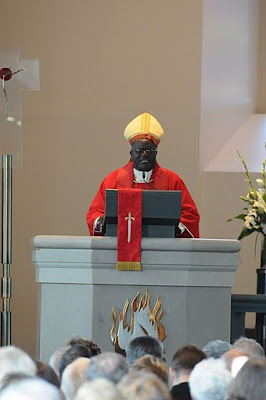
Watching the installation of Synidical President Matthew Harrison might have given many Lutherans opportunity to ask that as-old-as-the-Missouri-Synod question: "Are we becoming Roman Catholic?"

Short answer: no.
Long answer: no, of course not.

And yet, Archbishop Obare of the Lutheran Church in Kenya wore his mitre (mm hm, the pointy hat).

District President Stechholz carried a traditional bishop's crosier (mm hm, the shepherd's staff thingy).


There were crucifixes galore, from the processional ones to the pectoral ones, enough perhaps to outfit a Roman Catholic seminary.

So what's the point? The Lutheran Church is bigger than Missouri. Some Lutherans choose to have bishops, archbishops, mitres, and crosiers. Some don't. Are we to suppose that the African Lutherans are too Roman Catholic? No. Maybe simply that the Lutheran Church is quite catholic.

In any case, here's the whole, official album:


Tuesday, September 7, 2010

ATP: Why do we stand for the procession?

We stand out of reverence for Christ.

When there is a full procession, we stand and face the processional crucifix. It is also appropriate to bow toward the cross and make the sign of the cross as it passes, as a reminder that Christ has marked us with His cross in the waters of Holy Baptism.

I’ve noticed, too, that when there’s not a full procession, people still turn to face the pastor as I walk in. Why is that? That’s not something I’ve ever instructed people to do, but the do it instinctively, because they know what pastors are called to bring them: Christ.

We stand when a judge enters a courtroom, not because the judge is anybody important but because he occupied an office which we respect. The judge may be a nice guy or a jerk, but we don’t stand for him, we stand for his judicial office.

So when we stand for the procession, even when the pastor’s the only one processing, we don’t stand for the pastor. We stand out of reverence for the Office of the Holy Ministry. The pastor may be a nice guy or a jerk, but we don’t care. Just like we make our pastors wear vestments to cover them up, to hide their uniqueness, to beautify the Office and cover the men who occupy that office, so when we stand, it’s not for the pastor, but for Christ. Standing out of reverence for Christ tells the pastor, “Buddy, we don’t care about you. We want you to give us Jesus. That’s what we made you promise to do at your ordination. That’s what we prayed for last night and this morning. We trust Christ’s Word and promise that He has sent you to us to give us His gifts.”

Pastors are nothing. The Office of the Ministry is Christ’s. Pastors are just the sacks of worms (to borrow Luther’s description of himself) God has chosen to fill that office, to use as His instruments. The Office is holy because Christ is holy. And we show reverence toward the Office because Christ uses it to bring us gifts of forgiveness, life, and salvation.

Growth

“To neglect your church, your prayer, your Bible study, your devotions, is to tell God that you have no desire to grow, to become more and more His child, that you are satisfied with being a weak and shaky Christian, and that you have had as much as you want from Him. How perilously such a person is slipping away from God. Everything that is not in accord with God's will is given over to death and the power of darkness. But, my friends, if we cling to Christ and His Word, growing daily in the will of God, striving to bring our lives into harmony with that will, what strength is ours, what then can harm us? When we are given over to the will of God, nothing can destroy, no more than God and His will can be destroyed. The unshakeable strength of the will of God is in us, though the world turn upside down.” (Dr. Norman Nagel,Selected Sermons, p. 245.)

Plain and simple, Christians grow.

So, are you growing? Or are you, as Pr. Nagel warns against, neglecting your church-going, your prayer life, your Bible study, your devotions?

How do Christians grow? Jesus describes it: “I am the true vine, and my Father is the vinedresser. Every branch in me that does not bear fruit he takes away, and every branch that does bear fruit he prunes, that it may bear more fruit. Already you are clean because of the word that I have spoken to you. Abide in me, and I in you. As the branch cannot bear fruit by itself, unless it abides in the vine, neither can you, unless you abide in me. I am the vine; you are the branches. Whoever abides in me and I in him, he it is that bears much fruit, for apart from me you can do nothing” (John 15:1-6).

If a branch grows, it’s not because the branch is particularly healthy but because the whole plant is healthy. Jesus is the vine. Every branch grafted into Him, every branch that remains in Him, grow and bears fruit.

We grow by abiding in Jesus and in His Word.

So I want to challenge you to set a goal for growing in Jesus, for growing as His disciple. The only way you will grow is with more Jesus, with more of His Word. The end result of the goal is not more of you, but more of Jesus.

Here are some sample goals. Pick or modify one or more to suit you and help you grow in Jesus.
• I currently attend church less frequently than I should. My goal is to attend every Sunday that I’m healthy.
• I do not currently attend Bible class (or Sunday school). My goal is to grow in the Word by studying it at Bible class.
• I do not currently have family devotions every day. My goal is to begin using the Congregation at Prayer to have family prayer and devotions every day.
• I currently do not attend the catechetical Service of Prayer and Preaching on Wednesdays. My goal is to make this a regular part of my weekly hearing and studying the Word of God.
• I currently do not begin and end each day with prayer. My goal is to use Luther’s orders of morning and evening prayer as a basis for beginning and ending each day.

You will have the opportunity to make one of these or a similar discipleship growth goal during the month of September. Every Christian grows. We grow by being in Jesus and in His Word. “If we cling to Christ and His Word, growing daily in the will of God, striving to bring our lives into harmony with that will, what strength is ours, what then can harm us? When we are given over to the will of God, nothing can destroy, no more than God and His will can be destroyed.”