Showing posts with label ceremony. Show all posts

Sunday, September 12, 2010

Crosiers, and Mitres, and Crucifixes! Oh my!

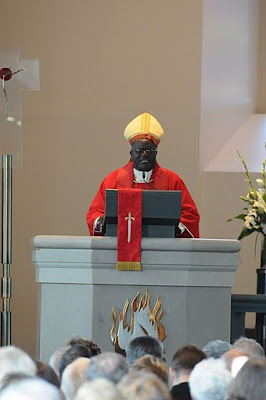
Watching the installation of Synidical President Matthew Harrison might have given many Lutherans opportunity to ask that as-old-as-the-Missouri-Synod question: "Are we becoming Roman Catholic?"

Short answer: no.
Long answer: no, of course not.

And yet, Archbishop Obare of the Lutheran Church in Kenya wore his mitre (mm hm, the pointy hat).

District President Stechholz carried a traditional bishop's crosier (mm hm, the shepherd's staff thingy).


There were crucifixes galore, from the processional ones to the pectoral ones, enough perhaps to outfit a Roman Catholic seminary.

So what's the point? The Lutheran Church is bigger than Missouri. Some Lutherans choose to have bishops, archbishops, mitres, and crosiers. Some don't. Are we to suppose that the African Lutherans are too Roman Catholic? No. Maybe simply that the Lutheran Church is quite catholic.

In any case, here's the whole, official album:


Tuesday, September 7, 2010

ATP: Why do we stand for the procession?

We stand out of reverence for Christ.

When there is a full procession, we stand and face the processional crucifix. It is also appropriate to bow toward the cross and make the sign of the cross as it passes, as a reminder that Christ has marked us with His cross in the waters of Holy Baptism.

I’ve noticed, too, that when there’s not a full procession, people still turn to face the pastor as I walk in. Why is that? That’s not something I’ve ever instructed people to do, but the do it instinctively, because they know what pastors are called to bring them: Christ.

We stand when a judge enters a courtroom, not because the judge is anybody important but because he occupied an office which we respect. The judge may be a nice guy or a jerk, but we don’t stand for him, we stand for his judicial office.

So when we stand for the procession, even when the pastor’s the only one processing, we don’t stand for the pastor. We stand out of reverence for the Office of the Holy Ministry. The pastor may be a nice guy or a jerk, but we don’t care. Just like we make our pastors wear vestments to cover them up, to hide their uniqueness, to beautify the Office and cover the men who occupy that office, so when we stand, it’s not for the pastor, but for Christ. Standing out of reverence for Christ tells the pastor, “Buddy, we don’t care about you. We want you to give us Jesus. That’s what we made you promise to do at your ordination. That’s what we prayed for last night and this morning. We trust Christ’s Word and promise that He has sent you to us to give us His gifts.”

Pastors are nothing. The Office of the Ministry is Christ’s. Pastors are just the sacks of worms (to borrow Luther’s description of himself) God has chosen to fill that office, to use as His instruments. The Office is holy because Christ is holy. And we show reverence toward the Office because Christ uses it to bring us gifts of forgiveness, life, and salvation.

Saturday, March 20, 2010

Next Adult Bible Class

Beginning the Sunday after Easter, the Sunday morning Bible class will take a look at Lutheran worship, exploring the whys, whats, and hows of the Divine Service. Come check it out Sunday mornings at 8:30. A few of us gather for Matins beforehand (8:00), followed by time for fellowship (and sometimes coffee and sweets) before Bible class and Sunday school begin.

There are lots of resources that you might check out to prepare you for the class, ranging from the simple to the academic. Here are a couple I'd recommend.

CPH has a book by Pr. Scot Kinnaman, Worshiping with Angels and Archangels: An Introduction to the Divine Service. The book is aimed at all ages but would be particularly useful for children and those new to the Lutheran way of worship in order to help them understand the Divine Service. Pr. Kinnaman's blog has two tremandous resources, as well: a primer on Lutheran Worship and a glossary of ecclesiastical terms. Check these out.

Another book from CPH that would make a great companion volume to Bible class is Pr. Timothy Maschke's Gathered Guests: A Guide to Worship in the Lutheran Church.

Other volumes you will find helpful include some of those that should be on the bookshelf of every Lutheran family: a hymnal, The Lutheran Study Bible, the Treasury of Daily Prayer, and the Book of Concord.

For a more academic look at the Divine Service these resources may prove helpful:
Luther's Works, volume 53
The journal Gottesdienst as well as Gottesdienst Online, the accompanying blog, are also great resources for learners of the Lutheran Divine Service.

So, there you have it. Come and learn!

Wednesday, February 17, 2010

So it begins

Lent, that is.
Here is Pr. Peters on ashes and the history of the custom.

Saturday, December 19, 2009

Monday, November 2, 2009

Walther: Reformation is Nothing New

It is true that of all the church bodies which have left the papacy, it is precisely the Lutheran Church which is accused of retaining many papal abuses and of having been the least successful in cleansing itself. It is pointed out, for example, that in our church priestly clothing, church ornamentation, pictures, altar, crucifixes, candles, confession, the sign of the cross, and the like are still apparent. But, my friends, whoever regards these innocent things as vestiges of the papacy knows neither what the papacy is, nor what the Bible teaches. The very fact that the Lutheran Reformation was not aimed at indifferent adiaphora, but retained those things which were in harmony with God's Word, shows that it was not a disorderly revolution, but a Biblical reformation. -- C. F. W. Walther

HT: Weedon

Tuesday, August 25, 2009

What we believe informs what we do in the Lord's Supper

We've had a very lively discussion in Sunday morning Bible Class the past few weeks about Article VII of the Formula of Concord, the article on the Lord's Supper. The conversation has dwelt for a long time on what effects the presence of Christ's Body and Blood. Is it the words of Jesus (the Verba) or the reception of the elements by the communicant? And, if Jesus' Body and Blood are present at His Words, how long does His presence continue? Indefinitely (until everything is consumed? Or only until the Supper is ended?

There's a lively debate happening at the Gottesdienst blog. It's scholarly but thorough.

If you check it out, read the posts in this order:

For my own part, I believe the Scriptural and Lutheran position is that the Words of Jesus bring about His presence, and that presence endures until everything is consumed. And my practice confesses that. Because Receptionism is nearly as prevalent as it is false, I genuflect during the consecration. And because any talk of the end of Christ's presence in the Supper is speculative at best, and an impious denial that the Word of the Lord endures forever at worst, I consume everything that has been consecrated.

If you're not getting enough of this conversation in Bible Class on Sunday mornings (or if you're note getting any of it), go read what these other faithful Lutheran pastors have to say on the issue and come back and discuss it here.

Monday, March 30, 2009

Passiontide Ceremonies

Where did the Gloria Patri go? Why did the processional crucifix and the altar wall cross get veiled in cloth? Petersen explains.

These ceremonies teach what no modern day chancel drama could (and I say that as one who's written and performed a chancel drama in a chancel...yes, yes, revoco!). Things that have been fairly consistent for a year suddenly disappear. And it's all come upon us suddenly. First we gave up singing "Alleluia" until we sing it either eternally at the Lamb's Wedding Banquet or at the Easter feast. Then we stopped singing the Gloria in Excelsis, the song of the Angels. Then gave up having full bellies. Now we've plunged even deeper into this penitential season.

And we're not done yet. On Maundy Thursday, the altar will be stripped bare (as if to mock us after having been draped again in joyous white paraments!). Good Friday will revel in black and darkness. And Holy Saturday will end with the transition from mourning into joy--from Lent into Easter--as the sun sets and we rejoice in the risen Son.